



What actually happens when a cable car suddenly comes to a stop and can’t be restarted? It’s a scenario no one wants to face, but one for which we at the Jennerbahn must be fully prepared. That’s why, once a year, we conduct an emergency drill together with the Berchtesgaden Mountain Rescue Service. This time, the drill focused on evacuating the Mitterkaser chairlift. Participating were 28 volunteer “passengers” from the Berchtesgaden Ski Club, the Königssee Volunteer Fire Department, and the Jennerbahn. The Berchtesgaden Mountain Rescue Service sent 11 mountain rescuers to the cable car training. In addition to the Jennerbahn, they are also responsible for the Götschenbahn and the Obersalzbergbahn.
Well Prepared for the Worst-Case Scenario
The law requires every cable car system to conduct a rescue drill once a year. The main goal is to practice the procedures and ensure that every step is executed perfectly in an emergency. “We use the same system across all our facilities. That’s why we can practice the procedures both on the cable car and, as we’re doing today, on the chairlift,” explains Alexander Eder, operations manager of the Jennerbahn.
What’s actually inside a mountain backpack?
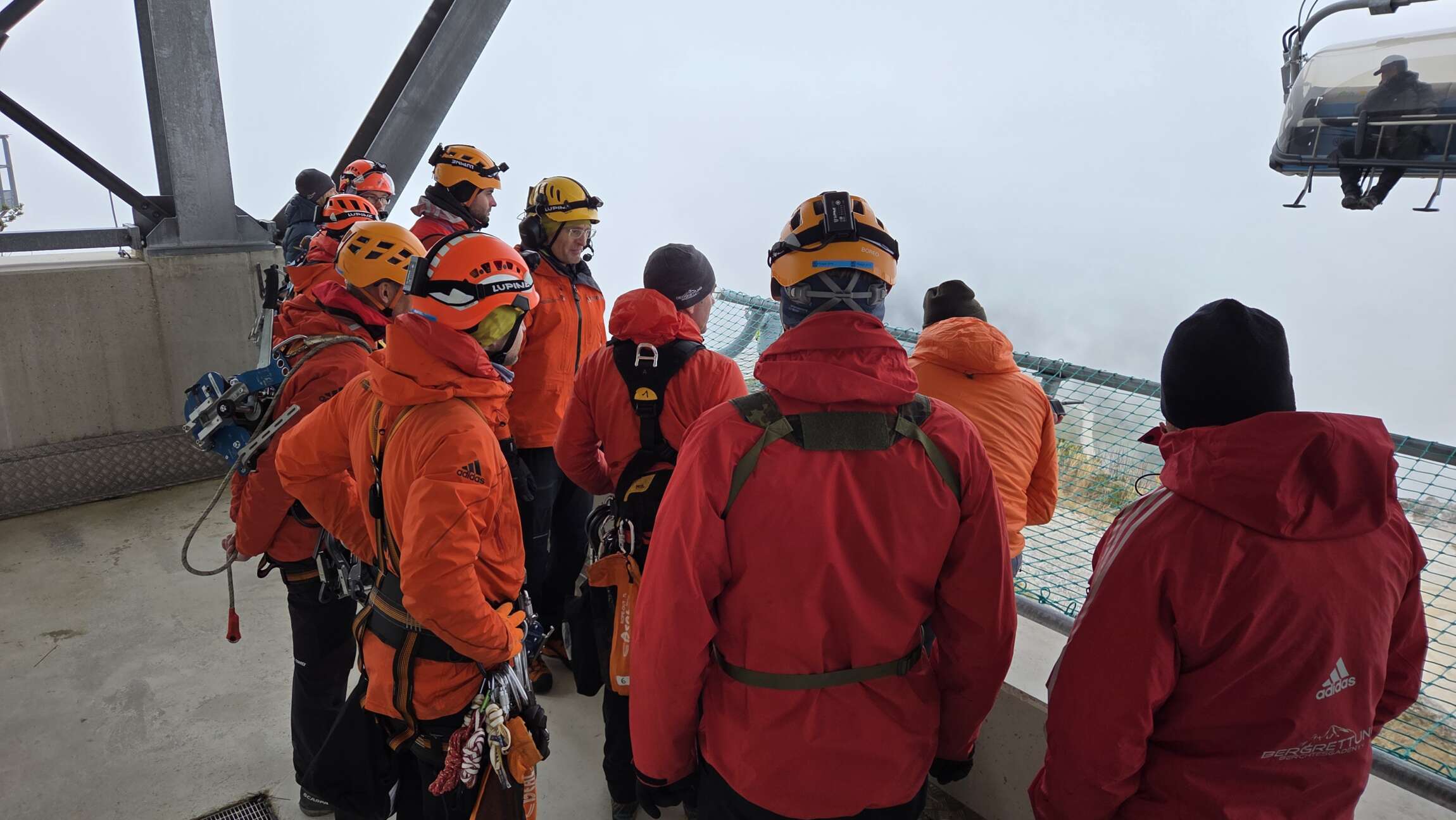
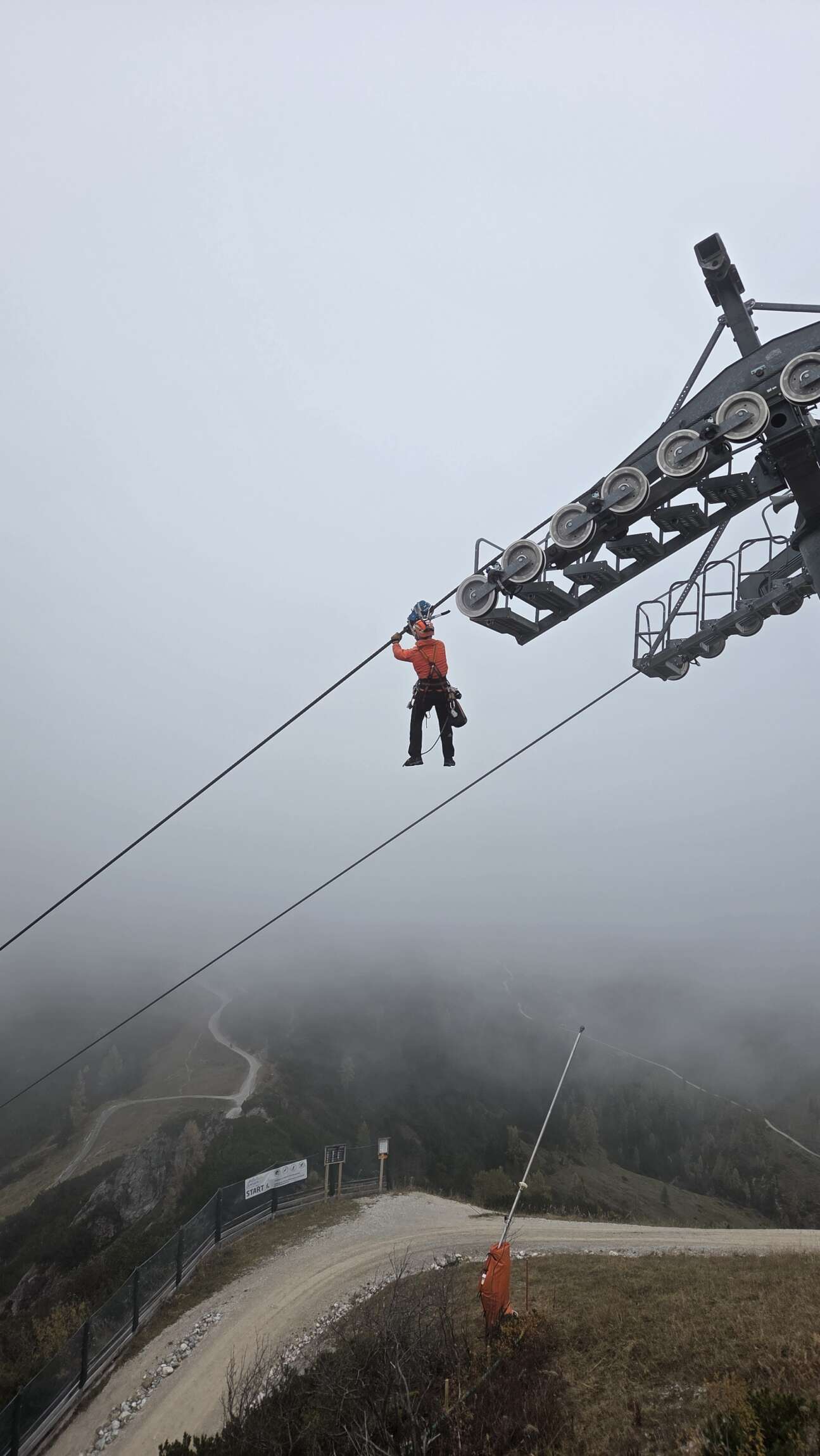
Before we get to the actual rescue, let’s take a look at the mountain rescuers’ equipment. They carry everything needed for a cable car evacuation in what are called rescue packs. Each pack weighs about 20 kilograms. Inside, you’ll find ropes, seat harnesses, webbing slings, and carabiners, among other items. The equipment also includes a centrifugal brake for controlled rappelling and a special rope-descent device. This allows rescuers to move directly along the rope from one support to the next.
“We train regularly on every chairlift,” says Franz Gummerer, head of operations for the Berchtesgaden Mountain Rescue Service. During rescues, the rescuers work in teams of two: one climbs over the support to reach the rope and tends to the people in the chair. His colleague waits on the ground, receives the people who have been rappelled down, and accompanies them to a safe landing area. This is a particularly challenging task in steep, rugged terrain. That’s because rappelling alone isn’t enough—the passengers must then be guided safely to ground that’s easy to walk on.
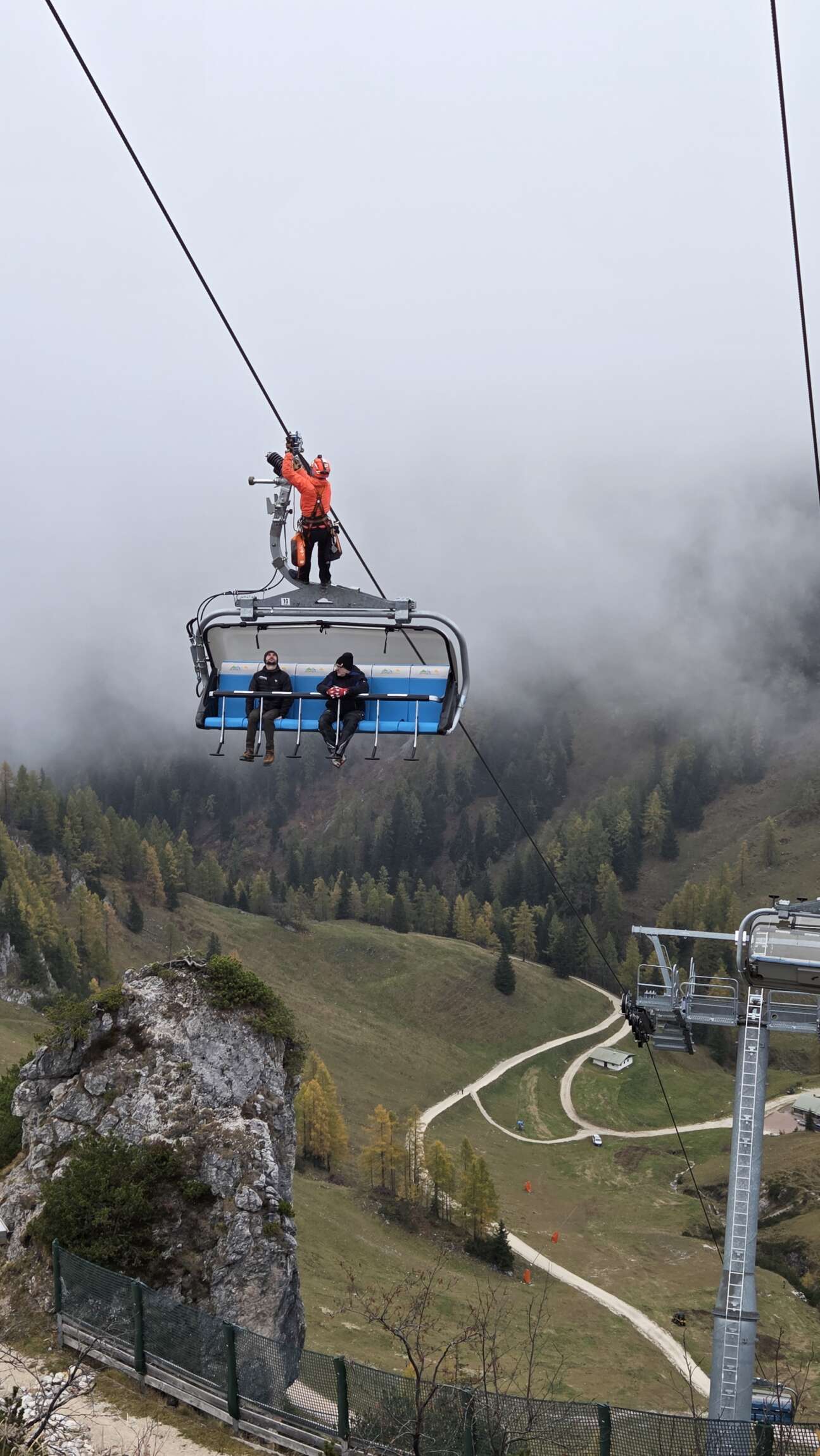
Now things are getting serious—at least for our volunteer participants. Little by little, they take their seats on the Mitterkaserbahn until the entire uphill section is filled with “passengers.” Joe and Angelika, both in their late 60s, are the first to board. The two of them wait quite relaxed in the front chairlift for their rescue.
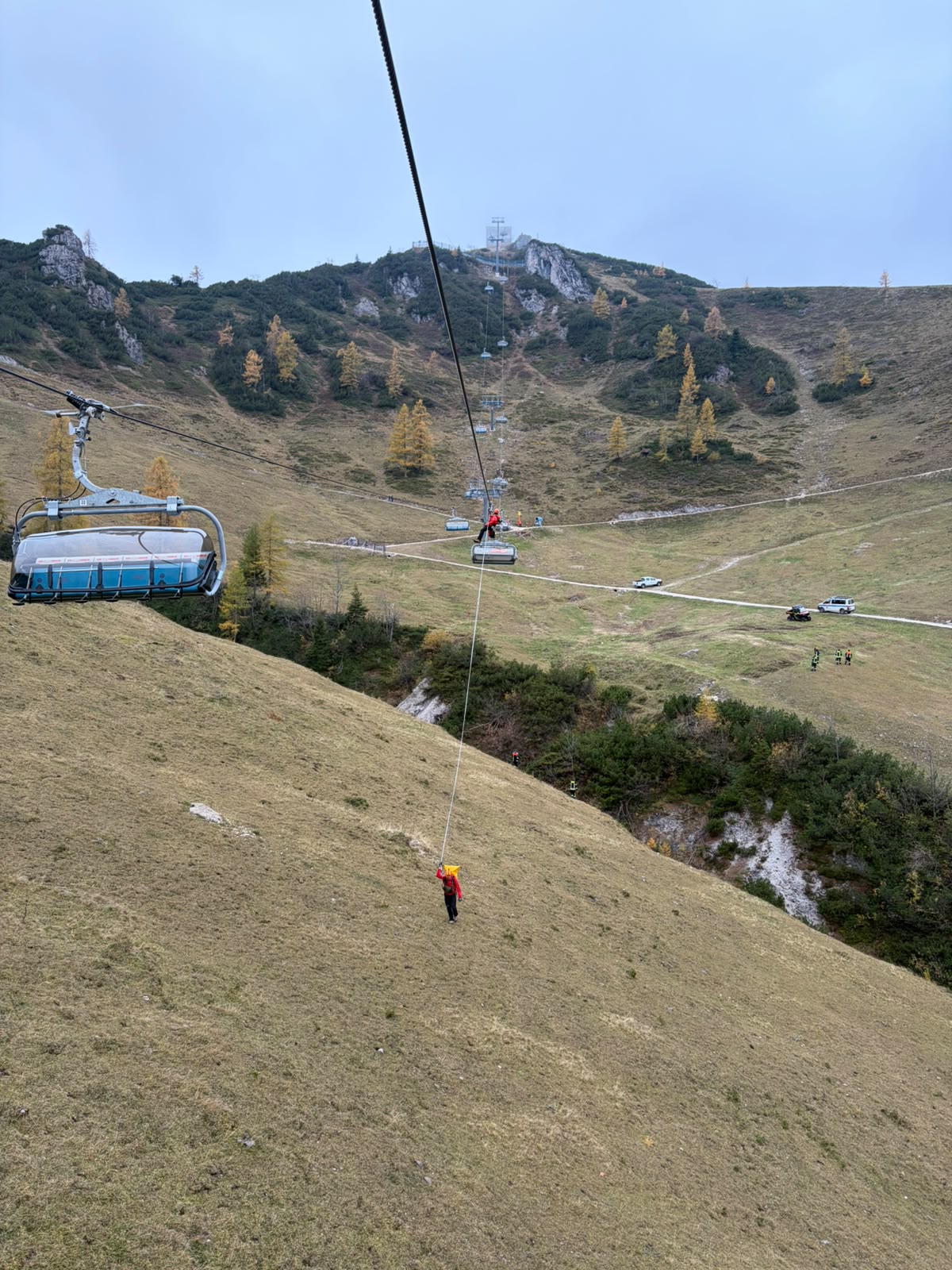
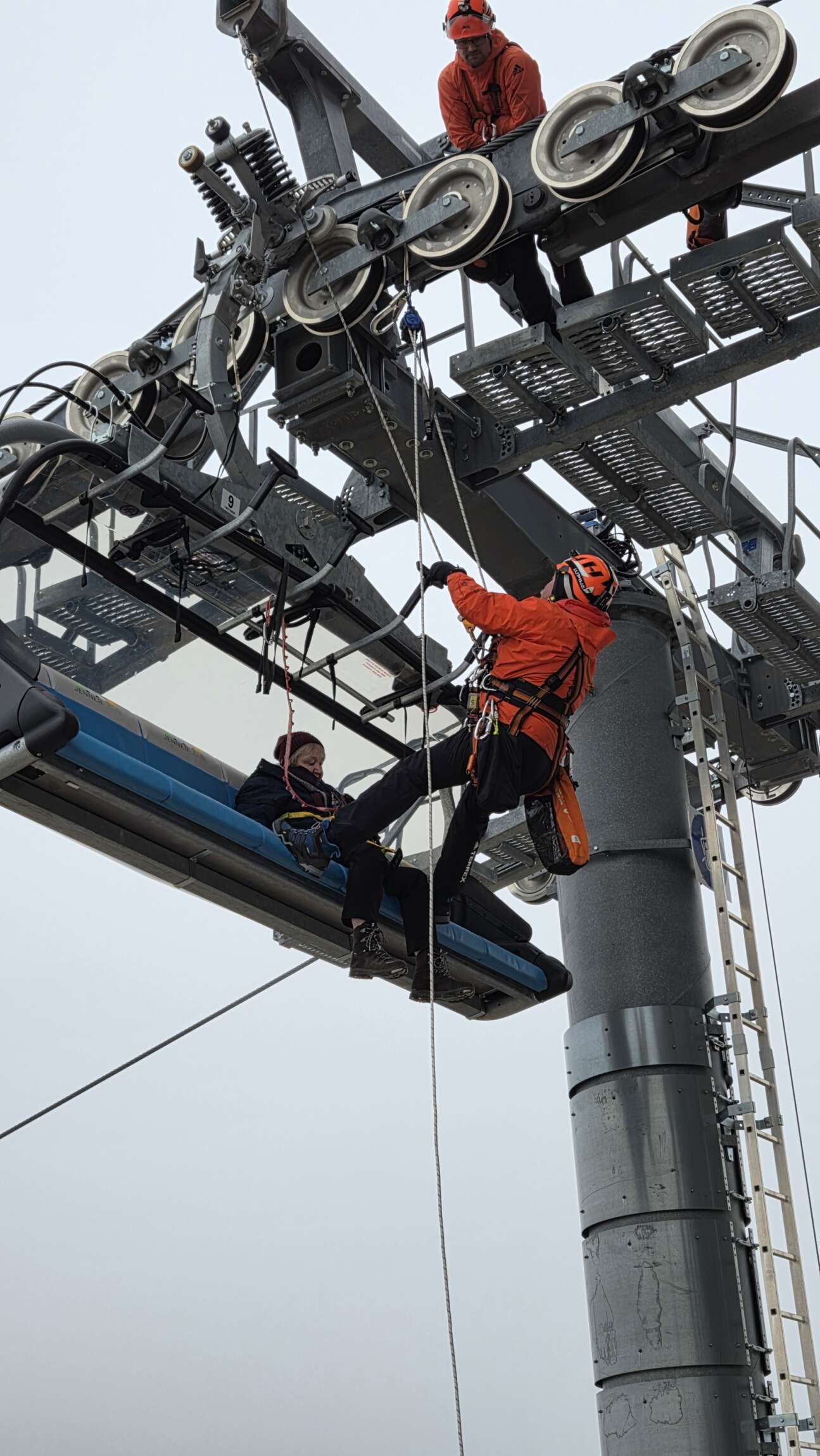
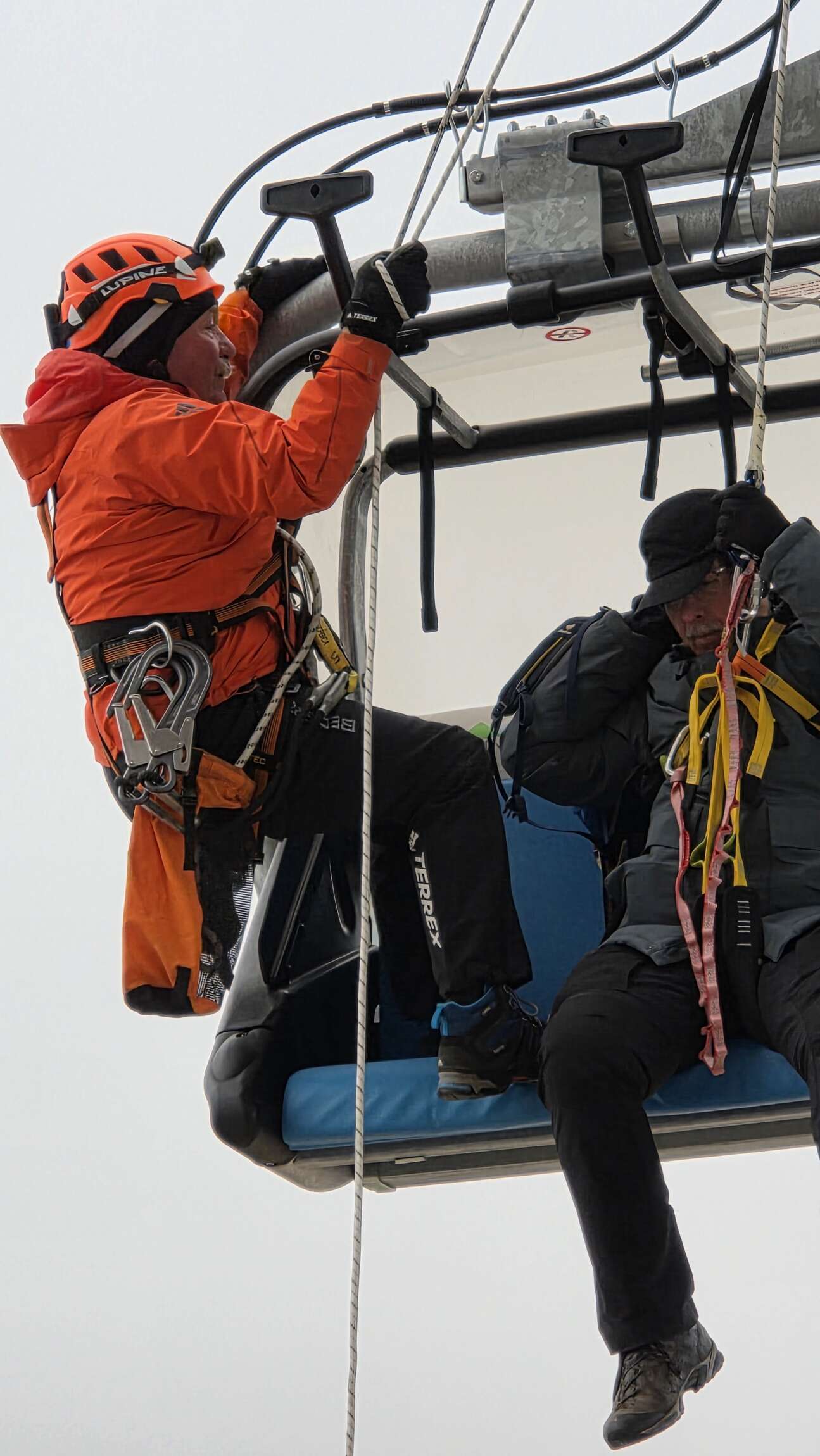
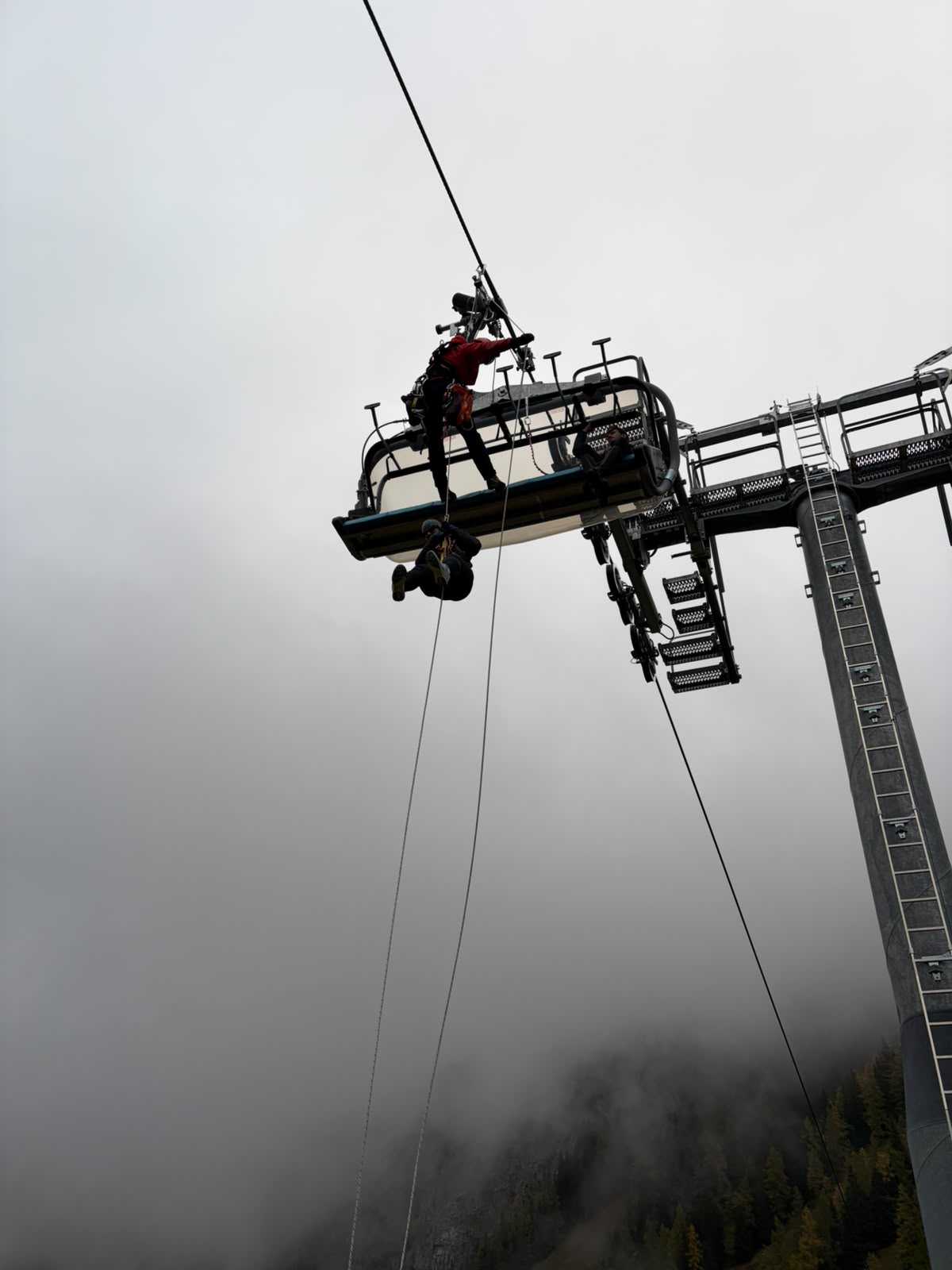
Three mountain rescuers are on duty in the upper section today: Sepp climbs up onto the support structure with Franz, while Christoph provides support from the ground. First, the rescuers secure themselves before Sepp climbs down to the chairlift. Angelika is fitted with a seat harness. She is then carefully lowered by rope to Christoph on the ground. To do this, she has to slide forward a bit and let herself glide out of the chair on her own. The centrifugal brake ensures that she descends safely at a speed of about one meter per second. After about 15 minutes, both passengers have arrived safely on the ground.
When there are children on board
The next passengers are already waiting in another chairlift: Moni, herself a member of the Berchtesgaden Mountain Rescue Service, is here with her two daughters, Frieda (7) and Heidi (5). “I took the opportunity to join my children for a training exercise. Rescuing children is a particularly sensitive issue that we rarely get to practice. Children aren’t yet able to assess the situation on their own. That’s why every move has to be executed perfectly,” explains Moni. That’s why it’s especially important for the mountain rescuers to practice these kinds of situations regularly. Frieda and Heidi, however, take it all in stride. After their rescue, the two are beaming from ear to ear: “That was really fun. We weren’t scared at all and would love to do it again!”
Teamwork matters behind the scenes, too
It’s not just the mountain rescuers and volunteer passengers who are called upon during the drill. Victoria from the Jennerbahn marketing team also volunteered to participate. “For us in the office, it’s important to know what’s happening on the lift, because in an emergency we also need to communicate quickly and accurately,” she explains. She felt safe throughout the entire exercise. The instructions were calm and clear. The only thing that took a bit of effort was sliding out of the chair. And the temperatures were also a minor challenge. The actual rescue, on the other hand, went really quickly.
After an hour and a half, the drill was complete
After about an hour and a half, the mountain rescue team successfully evacuated the entire route of the Mitterkaser chairlift. All volunteer passengers arrived safely back on the ground.
To wrap things up, everyone involved gathered for a snack together at the Halbzeit restaurant. Alexander Eder, operations manager of the Jennerbahn, and Stephan Bauhofer from the Berchtesgaden Mountain Rescue Service thanked the volunteer participants and the emergency responders for their support and excellent cooperation.
A heartfelt thank you to everyone who participated in this year’s mountain rescue drill!